Climbing Mount Fuji 2026 is officially a go — Japan’s most iconic mountain opened for the summer season on July 1, and hundreds of thousands of hikers will chase the sunrise from its 3,776-meter summit before the trails close on September 10. If Mt. Fuji is on your bucket list, this is your year — but the climb now takes real planning: there’s a ¥4,000 hiking fee, entry gates that shut at 2:00 p.m., and hut beds that sell out weeks in advance.
Here’s your complete, step-by-step guide — dates, costs, the best trail for your level, and the mistakes that get climbers turned away at the gate.
@japantovisit / Climbing Mount Fuji 2026
Climbing Mount Fuji 2026: Key Facts at a Glance
| Item | Details |
|---|---|
| Season |
Yoshida & Subashiri trails: July 1 – Sept 10 Fujinomiya & Gotemba: July 10 – Sept 10 |
| Hiking fee | ¥4,000 — about US$27 per person, all four trails |
| Booking | Online, in advance — official site for Yoshida, or Shizuoka Fuji Navi app for other trails |
| Daily cap | 4,000 climbers per day on Yoshida, with mountain-hut guests exempt. No cap elsewhere. |
| Gate hours | Closed from 2:00 p.m. to 3:00 a.m. without a mountain-hut reservation |
| Summit height | 3,776 m / 12,389 ft |
Step 1: Pick Your Trail
Mt. Fuji has four official routes, all starting from a “5th Station” partway up the mountain. Your choice shapes the whole climb:
| Trail | Start altitude | Ascent time | Crowds | Best for |
|---|---|---|---|---|
| Yoshida | ~2,300 m | 5–7 hrs | Heavy — 4,000/day cap | First-timers — most huts, easiest access from Tokyo |
| Fujinomiya | ~2,400 m | 4–7 hrs | Moderate | Shortest route to the top |
| Subashiri | ~2,000 m | 5–8 hrs | Light | Scenic forest start, merges with Yoshida higher up |
| Gotemba | ~1,400 m | 7–10 hrs | Very light | Experienced, fit hikers only |
Mt. Fuji has four official routes, all starting from a “5th station” partway up the mountain. Your choice shapes the whole climb:
Our pick for most readers: the Yoshida Trail. Direct buses run from Shinjuku, it has the most mountain huts and toilets, and separate up/down paths. The trade-off is crowds — which is exactly why the reservation system exists.
Step 2: Book Your Slot (Don’t Skip This)
You can no longer just show up. For climbing Mount Fuji 2026, every hiker going beyond the 5th station pays the ¥4,000 fee and books in advance:
- Yoshida Trail: reserve and pre-pay on the official Mt. Fuji climbing website. Bookings opened April 27 and close at 11:59 p.m. the day before your climb — but popular dates fill early, so don’t wait.
- Subashiri, Gotemba, Fujinomiya: pre-register through the Shizuoka Fuji Navi app, complete a short safety module, and carry your QR-code permit.
- Hikers who only walk up to the 5th station (not beyond) don’t pay the fee.
At the gate, staff check that you have proper hiking boots, two-piece rain gear, and warm clothing — sneakers or a poncho can get you refused entry.
Step 3: Reserve a Mountain Hut (Separately!)
The trail fee does not include accommodation. Mountain huts must be booked and paid for on their own — and they’re the key to the whole experience:
- Expect roughly ¥10,000–¥17,600 per person for a weekday stay, usually with dinner (curry rice is the classic) and a packed breakfast.
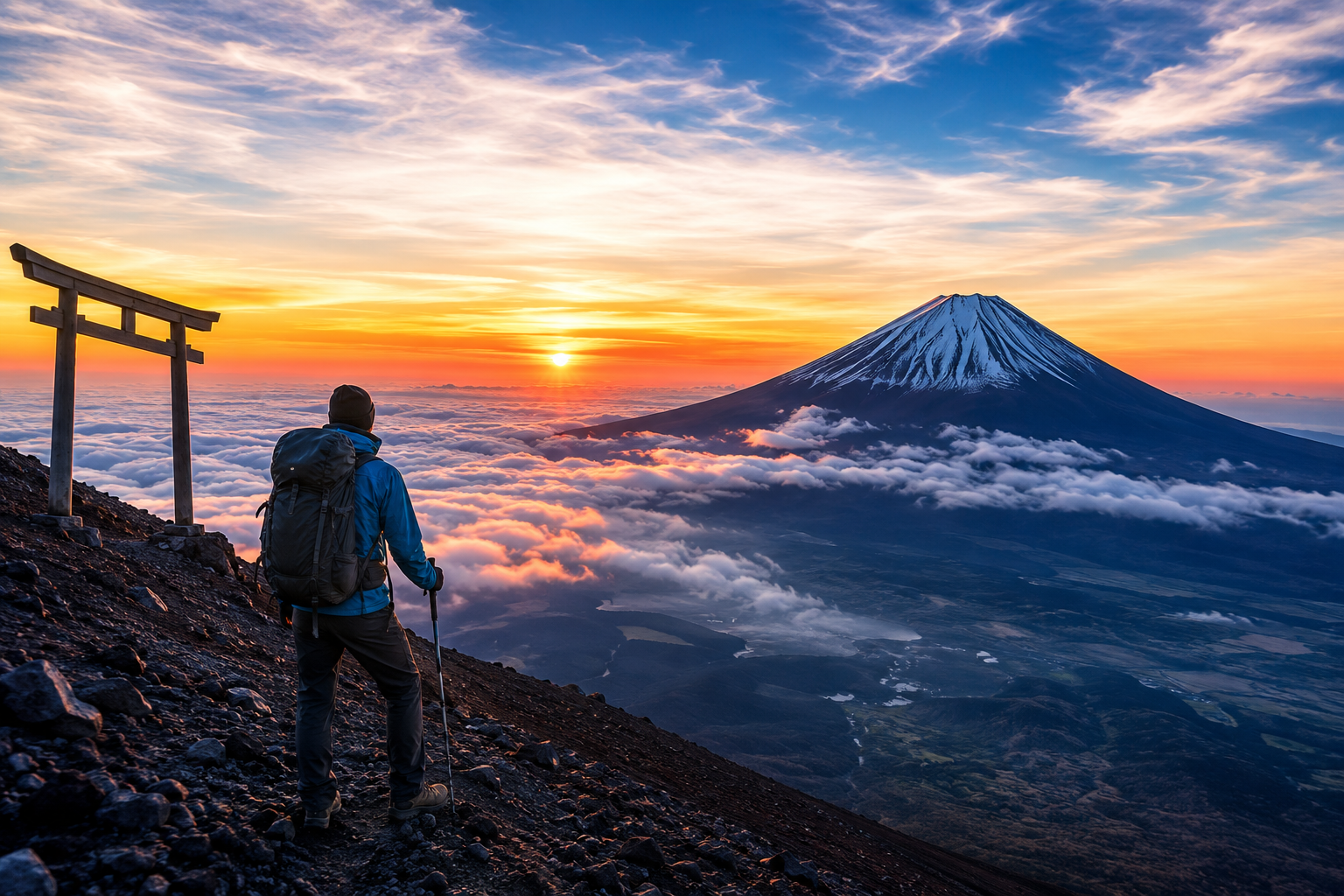
- Huts are basic — shoulder-to-shoulder bunks, not hotels — but a hut stay is what lets you summit for sunrise (goraikō), the moment everyone climbs Fuji for.
- A hut reservation also exempts you from the Yoshida daily cap and lets you pass the gate after 2:00 p.m.
Book the moment your dates are fixed. Obon week (mid-August) and weekends sell out first.
Step 4: Time It Right
The gates on all trails close from 2:00 p.m. to 3:00 a.m. to stop “bullet climbing” — racing to the top overnight without rest, which drives up hypothermia and altitude-sickness cases. So the classic, safest plan is:
- Day 1: Pass the gate before 2 p.m., climb 4–6 hours to your hut around the 7th–8th station, eat, sleep early.
- Day 2: Wake around 1–2 a.m., climb the final stretch in the dark, watch sunrise from the summit, descend by late morning.
Best dates: weekdays in the first half of July (before Japanese school holidays start ~July 20) or early September. You’ll get available huts and thinner crowds — early July weather is just a bit less stable.
Step 5: At the Summit — Don’t Miss Japan’s True Highest Point
Here’s the secret most climbers miss: the spot where you top out is not the highest point in Japan. Walk the Ohachi Meguri, the ~90-minute trail around the volcanic crater rim, to reach Kengamine peak — the true 3,776 m summit. From the Yoshida side it’s about 40 minutes further, and most people skip it. Don’t be most people.
(Note: check trail notices — the crater rim path has had temporary closures in early July.)
What to Pack
- Hiking boots (checked at the gate), two-piece rain gear, warm layers — it can be near-freezing at the summit even in August
- Headlamp for the pre-dawn summit push
- Cash: ¥100 coins for toilets (bring 20+), plus cash for huts and snacks
- Water and snacks — prices climb with altitude
- Your booking QR code, saved offline
Fuel matters too. Hut dinners are simple, so carb-load properly in the Kawaguchiko area before you climb — this guide to Japanese comfort food on japanDishes.com covers the dishes worth seeking out, from katsu curry to hearty hōtō noodles (the Fuji region’s specialty).
Rules Recap: Don’t Get Turned Away
Quick checklist of the 2026 regulations (full breakdown in our Mount Fuji Rules 2026 guide):
- ✅ ¥4,000 fee paid and booked in advance
- ✅ Through the gate before 2:00 p.m. (or hold a hut reservation)
- ✅ Proper boots, rain gear, warm clothing — inspected at the gate
- ✅ Follow instructions from Mt. Fuji rangers patrolling the trails
- ✅ Carry all trash out
- ❌ No bullet climbing, no fires, no sleeping on the trail
Frequently Asked Questions
Is Mount Fuji open for climbing in 2026? Yes — the 2026 season is officially open. The Yoshida and Subashiri trails run July 1 to September 10; Fujinomiya and Gotemba run July 10 to September 10. Climbing outside the season is prohibited.
How much does climbing Mount Fuji 2026 cost? Plan on ¥4,000 for the trail fee, roughly ¥10,000–¥17,600 for a mountain hut with meals, plus transport (about ¥3,000–¥6,000 round trip by bus from Tokyo) and extras like toilet coins and snacks. A realistic total is ¥20,000–¥30,000 per person.
Can beginners climb Mount Fuji? Yes — no technical climbing is involved, and the Yoshida Trail is genuinely beginner-friendly if you’re reasonably fit. The two-day itinerary with a hut stay is strongly recommended for first-timers to reduce altitude-sickness risk.
Can I climb Mount Fuji in one day? It’s possible on the Yoshida or Fujinomiya trails for fit hikers, but authorities discourage it, and the 2 p.m. gate cutoff makes it hard to do safely. The hut-stay itinerary is safer and gets you the summit sunrise.
How hard is climbing Mount Fuji? It’s a long, steep hike at altitude rather than a technical climb. The main challenges are thin air above 3,000 m, cold, and fatigue. Pace yourself, hydrate, and take the two-day option.
Do I need a guide to climb Mount Fuji? No, a guide isn’t required — trails are clearly marked and busy. Rangers patrol for safety. Guided tours exist if you’d prefer logistics handled for you.
Your Summit Awaits
Climbing Mount Fuji 2026 takes more paperwork than it used to — but the payoff hasn’t changed: standing on the roof of Japan as the sun rises over a sea of clouds. Book your slot, lock in a hut, pack real boots, and get through that gate before 2 p.m. The mountain will do the rest.
Keep planning on japantovisit.com:
- 📋 Mount Fuji Rules 2026 — Fees, Caps & Permits Explained
- 🚌 How to Get from Tokyo to Mount Fuji
- 🏨 Where to Stay Near Mount Fuji & Kawaguchiko
- 🎆 Tokyo Festivals July 2026: 8 Summer Matsuri
Season dates, fees, and rules are subject to change — always confirm on the official Mt. Fuji climbing website before you go.